Use Case Title
Parking Violation Detection System – Detecting Illegal Parking Using Computer Vision and YOLOv9
 Team Members
Pratiksha Chaubal
Karan Dohale
Akshat Gandhe
Rupali Kashid
 Use Case Importance
Parking violations are a major issue in urban areas, causing traffic congestion, blocked emergency routes, and reduced road safety. Manual monitoring of parking violations is time-consuming and inefficient.
Our Parking Violation Detection System uses Computer Vision and YOLOv9 to automatically detect illegally parked vehicles in real time. The system can help smart cities, traffic management authorities, and parking enforcement teams improve monitoring efficiency and reduce traffic-related issues through automated surveillance and alert generation.
 Data Collection and Annotation
We collected and prepared a dataset consisting of 500+ vehicle and parking violation images captured from different road conditions, parking zones, and lighting environments. The dataset included images of both legal and illegal parking scenarios to improve detection accuracy and model robustness.
We used YOLOv9 for training the detection model.
Classes Used:
- “Car”
- “Lines”
Dataset Preparation:
- Images were preprocessed and organized into training, validation, and testing datasets.
- Data augmentation techniques such as flipping, brightness adjustment, rotation, and resizing were applied to improve model generalization.
- Various vehicle types including cars, bikes, buses, and trucks were included in the dataset.
Dataset Split:
- Train – [1249]
- Validation – [808]
- Test – [149]
Sample Image:
 Model Training and Validation
We trained a YOLOv9 model using our parking violation dataset collected under different environmental and traffic conditions.
Metrics Monitored During Training:
- Precision
- Recall
- mAP (Mean Average Precision)
- Training and Validation Loss
During testing, we observed some false detections in crowded traffic scenes, partially occluded vehicles, and low-light environments. To improve performance, we added more diverse parking violation samples, increased nighttime data collection, and trained the model for additional epochs to improve stability and accuracy.
 Model Deployment and Demo
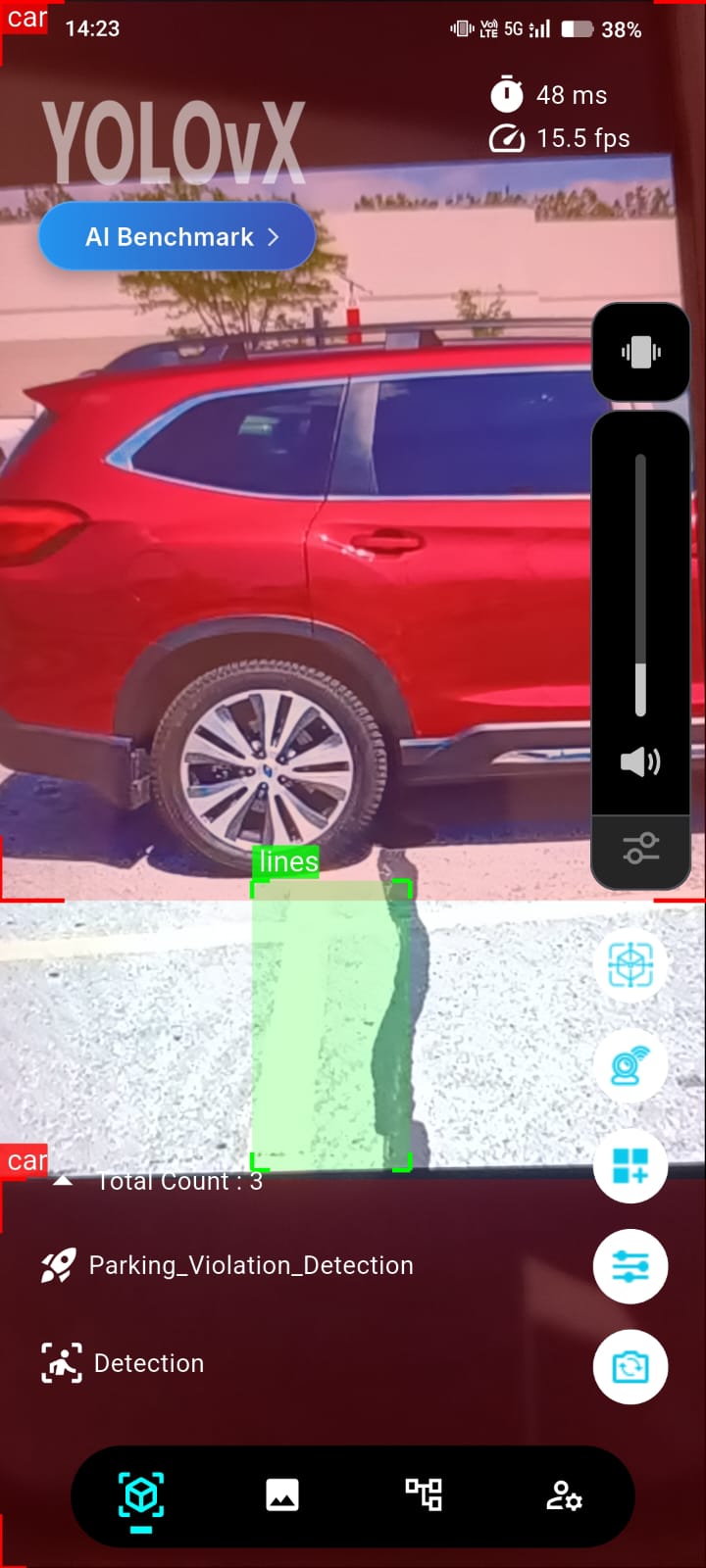
The trained model was deployed using the YOLOvX mobile application for real-time parking violation detection.
Deployed Model:
best.pt
Deployment Results:
- The system successfully performed real-time inference using mobile camera input.
- Testing showed accurate detection of illegally parked vehicles in most outdoor and urban environments.
- Minor lag and reduced detection accuracy were observed on lower-end devices and in extremely crowded scenes.
Performance:
- Approximately 5–10 FPS on mid-range smartphones
- Real-time parking violation detection with stable results
Demo Video Link
 Conclusion
Our YOLOv9-based Parking Violation Detection System successfully detected illegally parked vehicles in real-time scenarios with satisfactory accuracy during testing. The project helped us understand the importance of dataset preparation, annotation quality, environmental diversity, and model optimization in computer vision applications. We also gained practical experience in deploying AI models on mobile devices for smart traffic monitoring and urban management solutions.
 Special Thanks
I would like to express my sincere gratitude to Dr. Chandrakant Bothe and Prof. Sandeep Dwivedi for their constant guidance, encouragement, and valuable support throughout the internship and project development process. Their mentorship helped us better understand the practical applications of Artificial Intelligence and Computer Vision.