Fire Extinguisher Compliance Detection Model
Team Members
Pratik Yadav , Rudra Singh , Ammar Shaikh , Arkan Shaikh
Use Case Importance
Detecting fire extinguishers in real-time using computer vision can significantly enhance workplace safety and ensure regulatory compliance. In many countries including Germany, buildings are legally required to maintain fire extinguishers at certified locations. Manual inspection is costly, infrequent, and error-prone. Our solution automates this process using a mobile camera, helping facility managers verify compliance instantly without human intervention.
Data Collection and Annotation
We manually collected a total of 500+ real-world images from college corridors, laboratories, staircases, and building premises using a mobile camera. Each image was captured under varying lighting conditions, angles, distances, and occlusion levels to ensure the model generalizes well in practical environments.
All images were manually annotated using LabelMe, carefully drawing bounding boxes around each fire extinguisher to create precise ground truth labels. After manual annotation, augmentation techniques including flipping, brightness adjustment, rotation, and blur were applied to expand the dataset to 1500+ training images.
The dataset was split as follows: 1050 training images, 300 validation images, and 150 test images
Model Training and Validation
We trained the YOLOv9m model for object detection on Google Colab using a Tesla T4 GPU. Key metrics monitored were Precision, Recall, mAP@0.5, and mAP@0.5-0.95, and loss values including box loss, class loss, and DFL loss. During training, we analyzed visual metrics like confusion matrices, PR curves, and F1-score curves. Our results were logged in results.csv and visualized in plots like results.png and confusion_matrix.png.
Results achieved:
- Precision: 98%
- Recall: 95%
- mAP@50: 95%
- mAP@50-95: 80%
Model Deployment and Demo
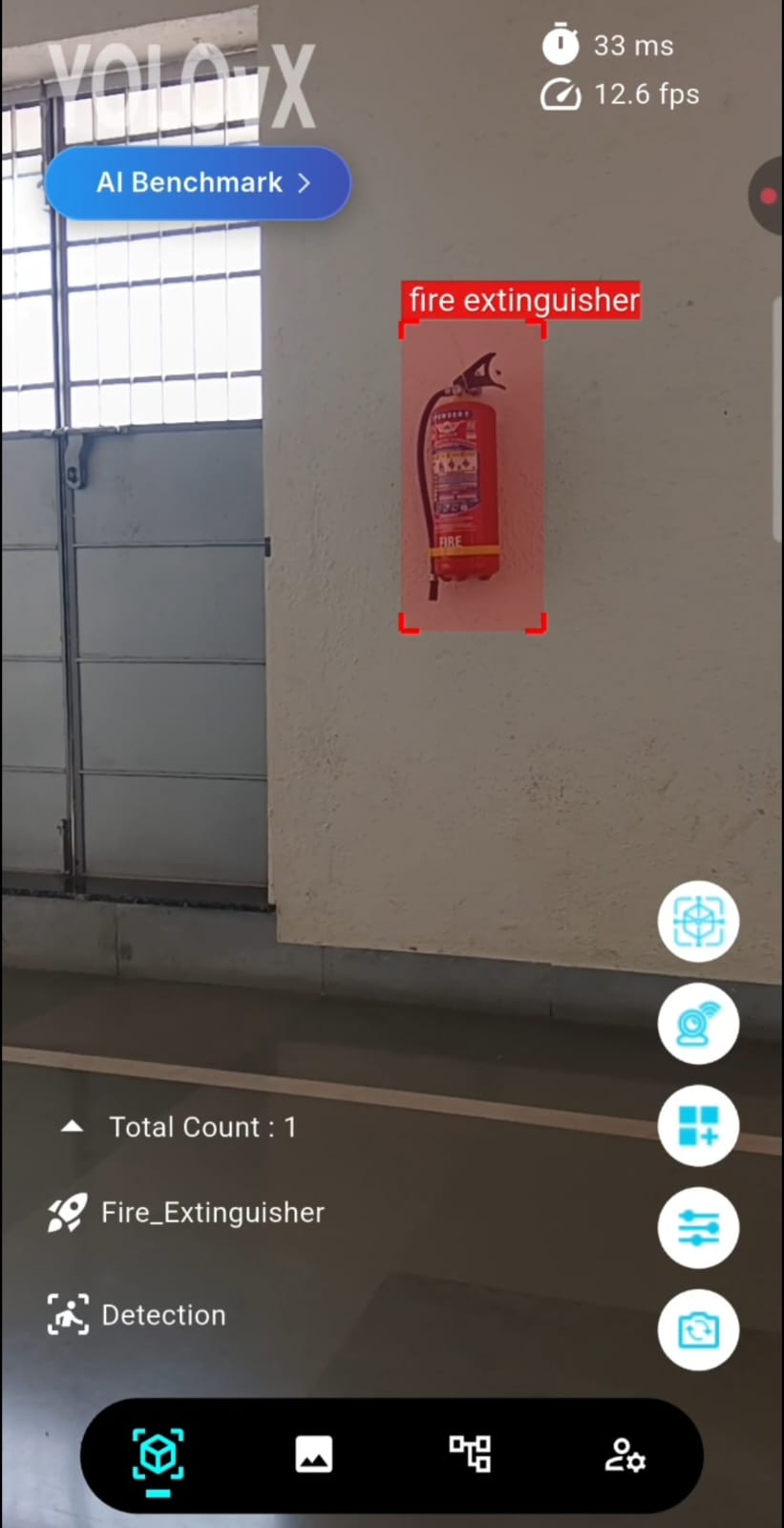
The trained model was deployed successfully on the YOLOvX mobile app by Wiserli, providing accurate and real-time detection with satisfactory FPS and performance. The model was also deployed as a web application using Streamlit showing COMPLIANT and NON-COMPLIANT status with confidence scores.
Live Web App: https://fireguardai-kb7caahuauzqhnbqm3mmzb.streamlit.app
GitHub Repository: GitHub - WindStack-cmd/FireGuardAI · GitHub
Conclusion
The model performed well in both web and live mobile tests, accurately detecting fire extinguishers with high precision and recall. We observed that lighting conditions, mounting positions, and viewing angles affected performance in some cases. Manual data collection from real college environments significantly improved the model’s ability to generalize in practical scenarios. A key learning was the importance of annotation consistency and dataset diversity to fine-tune the model effectively.
Thanks to Dr. Chandrakant Bothe Sir for this internship workshop which helped me gain hands-on experience in computer vision, real-world deployment, and practical AI development.