Helmet Detection – Detect students wearing/not wearing helmets on bikes near campus gates
 Group Members
Shinjinee Biswas
Gautam Gupta
Chetana Patil
Rishabh Tiwari
Chandani Yadav
 Use Case Importance
-
Campus Safety Initiative:
Ensure compliance with campus safety protocols.
Raise awareness about helmet usage among students. -
Traffic Violation Detection:
Integration with local traffic systems to monitor and report violations. -
Insurance Verification:
Provide evidence for compliance in case of accidents on campus premises. -
Educational Awareness Campaigns:
Utilize the system as a part of campaigns to promote helmet usage.
 Data Collection and Annotation
The dataset was created by recording videos around locations like the campus gate and residential society, capturing real-world scenarios. To introduce variation, additional videos were sourced from YouTube. Python was then used to extract frames from these videos, ensuring a diverse and comprehensive dataset for the project.
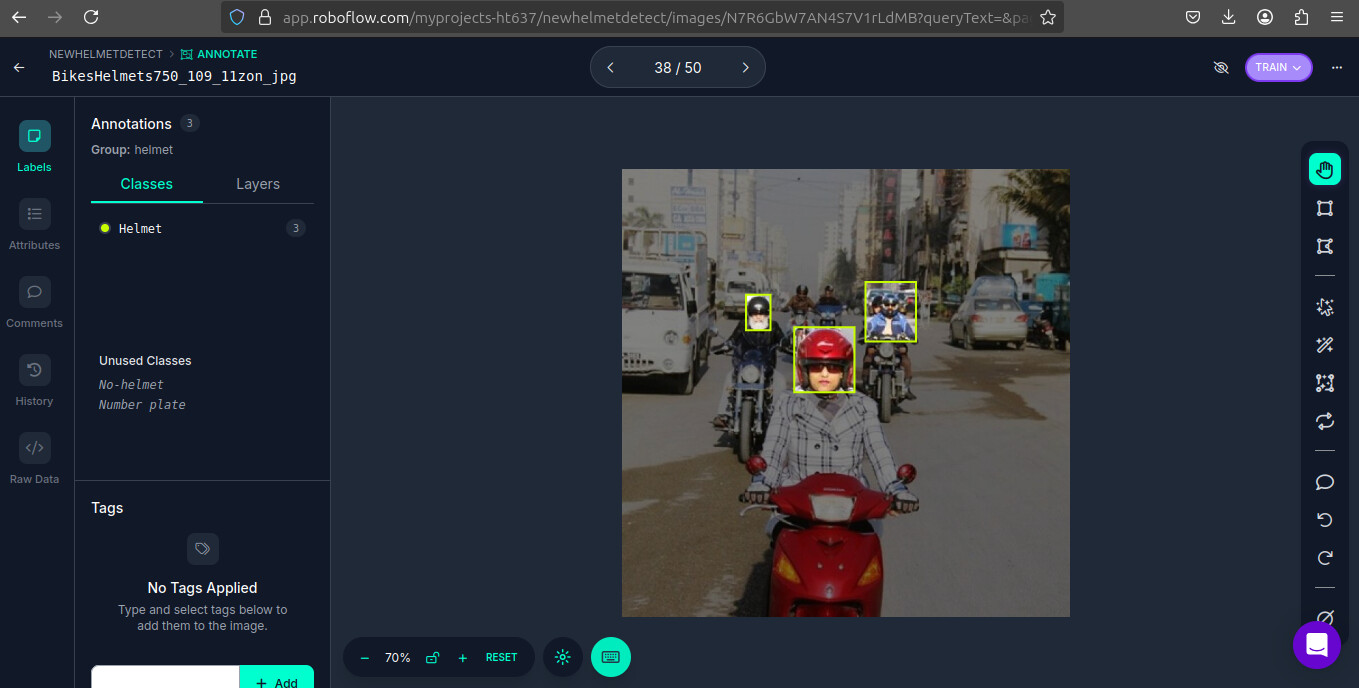
The dataset was prepared using Roboflow, where images were labeled to ensure accurate
annotations for training. Roboflow’s augmentation tools were then used to enhance dataset
diversity with techniques such as rotation, brightness adjustments, flipping, and cropping.
The augmented dataset was split into training, validation, and testing subsets and exported in YOLO format for compatibility with the YOLOvX model.
We had a total of 3 classes that is labels
Helmet
No-helmet
Number Plate
We had a total of around 2000 images which after various augmentations(rotate, crop, etc) led a 5 fold increase in total number of images while downloading dataset
Here are some examples
 Model Training and Validation
We trained the YOLOv9 model on an initial dataset comprising 2,000 images, which was divided into 1,400 training images, 400 validation images, and 200 testing images. During the training process, we monitored critical metrics such as mAP (mean Average Precision), precision, and recall to assess the model’s performance in detecting the four object classes: Helmet, No-helmet and Number plate class.
Following the initial training, we identified the need to enhance the dataset’s diversity and robustness. To achieve this, we applied data augmentation techniques such as mosaic transformations, scaling, and flipping to the existing dataset. These augmentations were introduced during the retraining phase, helping the model generalize better to varied scenarios and improve overall performance.
 Model Deployment and Demo Video
The deployed model achieved an average FPS of 7-8, showing moderate real-time performance but facing difficulty detecting fast-moving vehicles due to speed limitations. A single YOLOvX model was deployed in the mobile app to handle all detection tasks efficiently.
https://drive.google.com/drive/folders/1s61nA00R5s0grPtL_vcr681xGps3PK1E?usp=sharing
 Conclusion
Our model achieved an FPS of 7-8 in live deployment, with reliable detection under moderate conditions. We learned that optimizing for faster-moving vehicles remains a challenge, highlighting the importance of balancing speed and accuracy in real-world scenarios.