Illegal Parking Detection System Using YOLOvX
Team Members
Vidhi Jain, Pratik Kandu, Parth Chaudhari, Bhushan Desai, Abinav V.P.
Use Case Importance
Illegal parking is one of the major causes of traffic congestion and inefficient parking management in urban environments. Our AI-powered solution helps detect vehicles parked in authorized and unauthorized zones in real time using Computer Vision and YOLOvX.
This system can assist smart cities, colleges, parking authorities, and surveillance teams by automating parking monitoring and reducing manual effort.
Data Collection & Annotation
We collected a custom dataset of 1081 images from roads, parking areas, and college campuses under different lighting and environmental conditions. The dataset included various vehicles such as cars, bikes, buses, and trucks parked in both legal and illegal parking zones.
All images were manually labelled and annotated using Roboflow, where bounding boxes were created around every vehicle to ensure accurate object detection training.
The annotated dataset was exported in YOLO format and divided into training, validation, and testing sets for effective model evaluation.
Tools & Technologies Used
- Python
- YOLOvX
- Roboflow
- OpenCV
- NumPy
- Google Colab
Model Training & Validation
The model was trained using the YOLOvX framework for real-time object detection. During training, we monitored key evaluation metrics such as:
- Precision
- Recall
- mAP@0.5
- F1-Score
- Loss Curves
We also performed debugging, dataset refinement, and hyperparameter tuning to improve model accuracy in real-world environments.
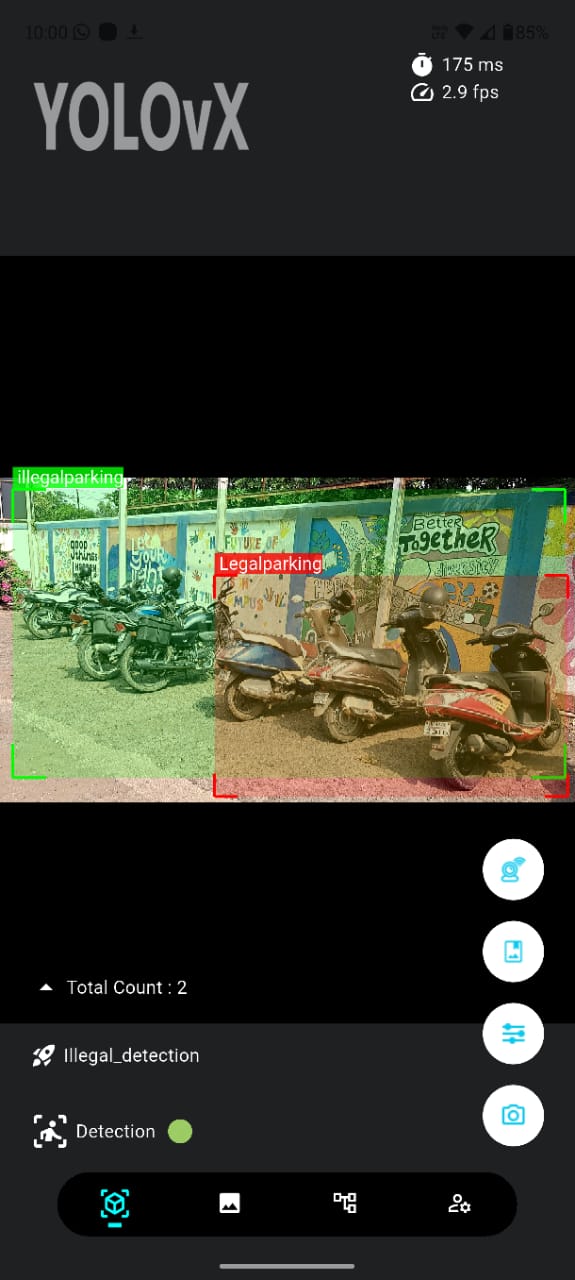
The trained model successfully detected vehicles and identified whether they were parked legally or illegally based on predefined parking zones.
Model Deployment & Testing
After successful training, the model was deployed on the YOLOvX mobile application for real-time testing.
The system was tested using:
- Live camera feed
- College campus parking areas
- Real-time vehicle detection scenarios
- IP camera integration
The application displayed:
- Bounding boxes
- Detection labels
- Parking status classification
- Real-time inference results
Challenges Faced
- Collecting diverse parking datasets
- Manual annotation of 1081 images
- Handling crowded parking scenarios
- Reducing false detections
- Real-time deployment optimization
These challenges helped improve our teamwork, debugging, and problem-solving skills throughout the internship.
Conclusion
The project successfully demonstrated how AI and Computer Vision can be used to solve real-world parking management problems.
Through this internship, we gained practical experience in:
- Dataset collection
- Manual image annotation
- YOLO model training
- Real-time deployment
- AI-based surveillance systems
This experience strengthened our understanding of Machine Learning, Deep Learning, and Computer Vision workflows while improving our practical industry skills.
Special Thanks
A sincere thanks to Dr. Chandrakant Bothe and the WISERLI Team for their mentorship, guidance, and support throughout the internship journey.
Project Links-
demo video link - Demo Video – Google Drive
Github Link - GitHub - abhinavv955/Illegal-Parking-Detection · GitHub