Smart Parking Slot Occupancy Detection Model
Team Members
Rutuja Gharat, Bhavya Davane, Ramesh Singh Chadhana, Shivanshu Mishra
Use Case Importance
Smart Parking Slot Occupancy Detection helps automate parking management systems by identifying whether parking slots are occupied or vacant in real time. This solution improves parking space utilization, reduces traffic congestion, minimizes parking search time, and supports smart city infrastructure using computer vision and deep learning technologies.
Data Collection and Annotation
We collected parking slot images from multiple real-world environments under different lighting conditions and parking angles to improve model robustness and real-time accuracy.
The workflow included:
- Image collection
- Image augmentation
- Data preprocessing
- Annotation using Roboflow
- Dataset preparation for YOLOv9 training
The dataset was annotated using bounding box annotations for occupied parking slots and vehicles.
Model Training and Validation
We trained the YOLOv9 model on Google Colab for parking slot occupancy detection. Multiple training experiments were conducted to achieve better accuracy and real-time performance.
Key metrics monitored during training included:
- Precision
- Recall
- mAP@0.5
- Loss values
We also analyzed validation outputs such as confusion matrices, detection results, and model performance visualizations.
Model Deployment and Testing
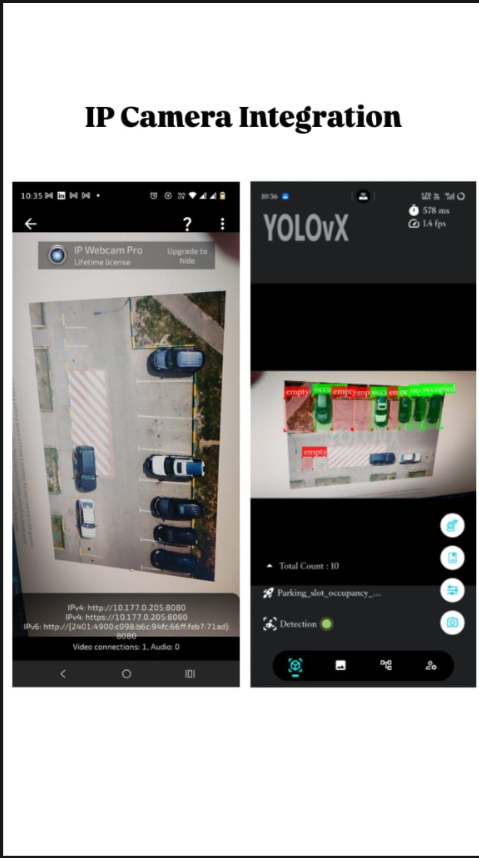
The trained model was deployed for real-time testing using IP Webcam implementation and OpenCV workflows.
The system successfully detected occupied and vacant parking slots in real-time scenarios with satisfactory accuracy and performance.
GitHub Repository Link:
Smart Parking Slot Detection Repository
Demo Video Link:
https://drive.google.com/file/d/12ZrwfpUmXGRphM2Kpn-TIwc74Nhv4yE0/view
Key Learnings
Through this project, we gained hands-on experience in:
- Computer Vision
- Deep Learning
- Object Detection
- YOLOv9 Training & Deployment
- Dataset Preparation & Annotation
- OpenCV & Google Colab Workflows
- Real-time AI-based Detection Systems
Conclusion
The Smart Parking Slot Occupancy Detection model performed effectively in real-time testing and demonstrated strong potential for automated parking management systems and smart city applications.
We observed that lighting conditions, parking angles, and dataset diversity directly affected model performance. Continuous experimentation, annotation consistency, and dataset optimization helped improve the overall detection accuracy and robustness of the system.