Two-Wheeler vs Four-Wheeler Detection Model
Team Members
Siddharth Jadhav, Krish Chorghe, Prajwal Kambale, Pranay Kumbhar
Use Case Importance
Detecting and classifying two-wheelers and four-wheelers in real time can greatly enhance traffic monitoring, road safety, parking management, and smart surveillance systems. Our solution leverages computer vision to accurately identify vehicle types from live and recorded video feeds, enabling faster and more reliable traffic analysis in real-world environments.
Data Collection and Annotation
We collected images and video frames of two-wheelers and four-wheelers from different real-world environments, covering variations in lighting conditions, background complexity, camera angles, object scale, and partial occlusion. The dataset was annotated into two classes: 2 Wheeler, 4 Wheeler. Annotation was done using CVAT / LabelImg in YOLO format. The dataset was split into training and validation sets for supervised object detection training.
Model Training and Validation
We trained the YOLOvX model for vehicle detection. Key metrics monitored were Precision, Recall, F1-score, and mAP. During training, we monitored training loss and validation accuracy across epochs. The model showed gradual improvement in detecting vehicle patterns and generating accurate bounding box predictions. Configuration files and training parameters were tuned according to project requirements.
Model Deployment and Demo Video
The trained model was deployed successfully on the YOLOvX App, providing real-time vehicle detection with satisfactory inference speed and accuracy under normal traffic conditions.
Images :
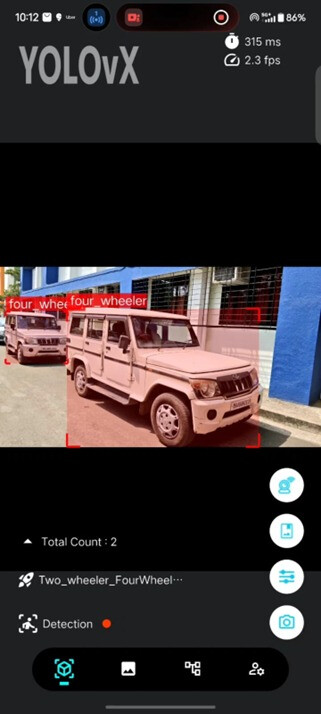
Demo Video Link -Demo Video
Conclusion
The model performed well in daylight and moderate traffic conditions, successfully detecting and classifying two-wheelers and four-wheelers with proper bounding boxes and labels. We observed that low-light conditions and highly crowded scenes affected detection accuracy. Key learnings included maintaining annotation consistency, proper dataset organization, and iterative parameter tuning to improve model generalization. Thanks to Dr. Chandrakant Bothe sir for this Internship workshop, which helped us gain practical exposure to Computer Vision and AI-based object detection.