 Use Case Title
Waste Detection System – Real-Time Multi-Class Waste Identification Using YOLOv11n
 Team Members
Shubham Bisht
Jay Maurya
Dhiraj Mahajan
Gurubachan matharu
 Use Case Importance
Efficient waste segregation is essential for smart waste management and environmental sustainability. Manual waste monitoring is time-consuming, error-prone, and difficult to scale in real-world environments.
This project focuses on real-time waste detection and classification using AI-powered Computer Vision techniques. The system automatically identifies different categories of waste, helping improve intelligent waste sorting, environmental monitoring, and smart city automation systems.
The project demonstrates how lightweight object detection models can enable scalable and efficient waste management solutions in practical real-world scenarios.
 Data Collection and Annotation
Data Collection:
Waste images were collected from multiple real-world environments under varying lighting conditions, object distances, camera perspectives, and background complexities. Additional dataset diversity was introduced to improve model robustness under dynamic environmental conditions.
Annotated Classes:
• Paper Waste
• Plastic Waste
• Glass Waste
• Metal Waste
Annotation Tool:
Roboflow
Dataset Features:
The dataset was structured using diverse waste conditions, cluttered scenes, varying object orientations, partial visibility cases, and multiple environmental scenarios to improve detection consistency and inference reliability.
Sample Images:
 Model Training and Validation
Model & Version:
YOLOv11n (nano) from Ultralytics trained on Google Colab.
Training Environment:
Google Colab with NVIDIA T4 GPU acceleration.
Training Focus:
• Real-time inference optimization
• Confidence score improvement
• False detection minimization
• Detection consistency enhancement
• Lightweight deployment performance
Monitored Metrics:
• mAP@0.5
• Precision
• Recall
• Training Loss
• Validation Loss
Optimization Techniques:
Multiple training experiments and hyperparameter optimizations were performed to improve detection accuracy and real-time inference performance across challenging environmental conditions.
The model was extensively tested under:
• Low-light environments
• Cluttered backgrounds
• Partial object visibility
• Different object appearances
• Dynamic environmental conditions
For further details on training a custom model, please refer to this Github link:
GitHub Repository Link Here
 Model Deployment and Demo Video
Performance:
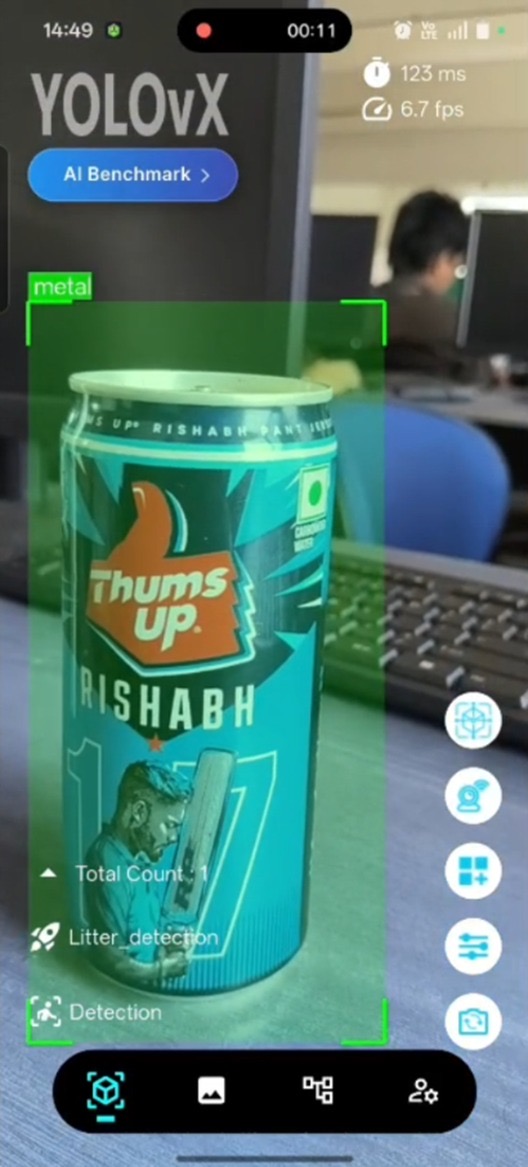
Achieved reliable real-time inference performance with optimized detection accuracy for waste classification tasks.
Deployment:
Model trained and tested for real-time AI-powered waste monitoring applications.
Demo Video:
 Conclusion
The YOLOv11n-based Waste Detection System successfully demonstrated accurate real-time waste classification using lightweight Computer Vision models.
This project provided practical exposure to the complete AI development lifecycle including dataset preparation, annotation, training, optimization, validation, and deployment-oriented experimentation.
Key learnings included the importance of dataset diversity, environmental robustness, and optimization techniques for building scalable AI-powered monitoring systems for smart cities and intelligent waste management applications.
 Trainers
Chandani Yadav
Nidhi Thakur
Aditya Behera
 In Guidance
Sandeep Dwivedi
Dr. Sunny Sall
In Collaboration With
Dr. Chandrakant Bothe
YOLOvX
#YOLOv11 yolovx #ComputerVision #DeepLearning #ObjectDetection #ArtificialIntelligence #MachineLearning #Roboflow #Ultralytics #AIProjects #WasteDetection #SmartCity #OpenCV #GoogleColab #Python #RealtimeDetection #EdgeAI #Automation #InternshipProject